Adaptive Beam Assist
Reducing glare without removing human control
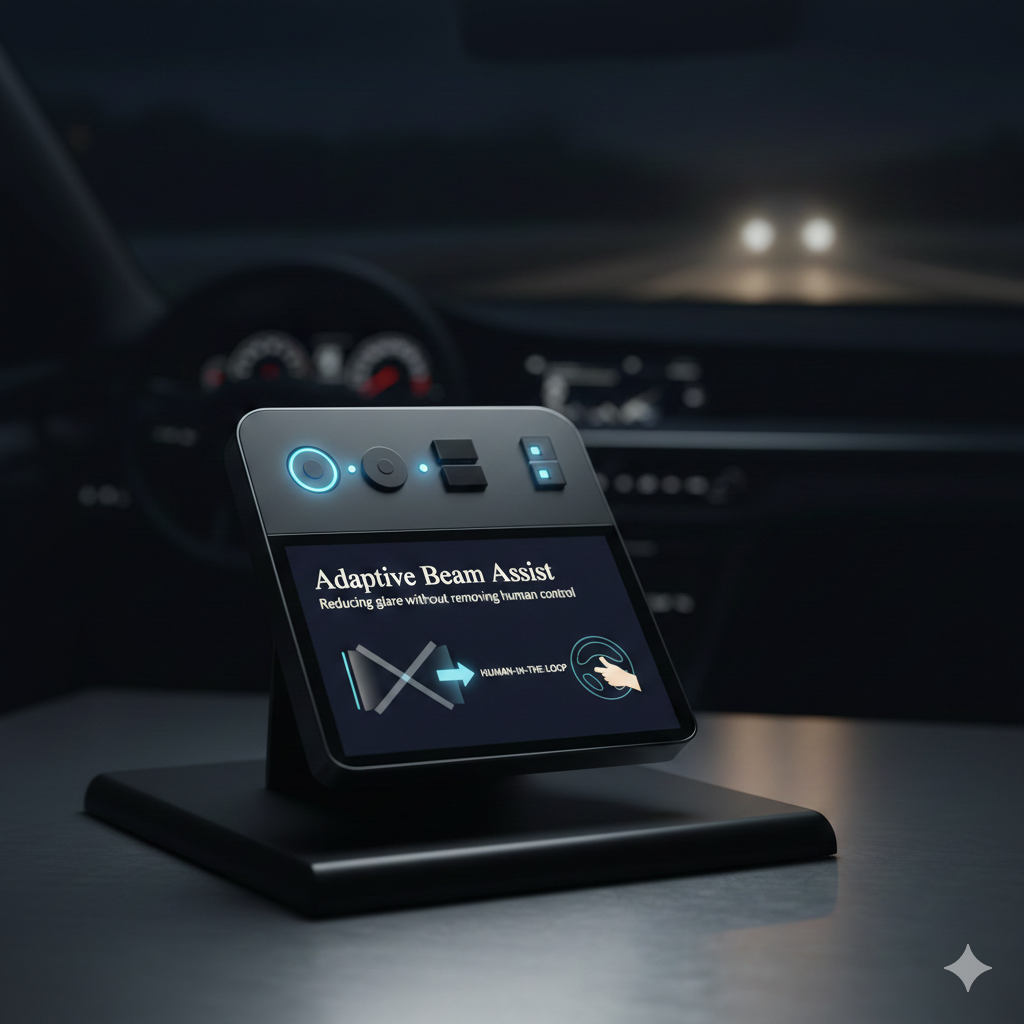
High-beam headlights are a major source of nighttime driving risk. Fully automated systems can misfire, while manual control relies on driver attentiveness under stress.
The challenge is balancing safety, trust, and regulation.
The constraint space
- Automotive safety systems are heavily regulated
- Full automation introduces liability and trust risks
- False positives can cause harm
- Drivers must retain authority and understanding
The key decision
I chose to design an assistive system, not an autonomous one.
Adaptive Beam Assist detects potential glare conditions and prompts the driver, rather than acting unilaterally. The human remains in the loop.
This aligns with regulatory realities and preserves driver trust.
System Description
A prototype system that:
- Establishes a baseline ambient light condition
- Detects sudden increases consistent with oncoming headlights
- Signals the driver through visual feedback
- Allows manual confirmation to dim beams
- Restores full brightness when conditions normalize
The system prioritizes clarity and reversibility over automation.
Trade-offs and failure modes
- Requires driver engagement
- Does not eliminate all glare scenarios
- Prioritizes safety over convenience
These trade-offs reduce liability and align with current automotive legislation.
Real-world viability
As a driver-assist feature, this system could:
- Integrate into existing vehicle lighting modules
- Serve as a training or transitional safety system
- Extend to bicycles, scooters, or low-cost vehicles
By avoiding full automation, the system remains legally and ethically deployable.
Key Takeaways
- Design under regulatory and safety constraints
- Balance automation with human judgment
- Build systems that respect failure and responsibility